Not All Room Modes Are Equal: Why Some Boom and Others Don't
Run your room through a mode calculator and you'll see something alarming: dozens of resonant frequencies, many of them clustered within a few Hz of each other. It looks like your room is a disaster.
But play some music and it probably sounds... fine. Maybe a little boomy in certain spots, but not the catastrophe the numbers suggest. What's going on?
The answer is that most room modes don't matter much. A handful matter a lot. Knowing which is which changes how you think about placement, treatment, and whether you actually need to do anything at all.
Three things that make a mode audible
A mode needs three ingredients to be a real problem. First, it needs energy. Axial modes (bouncing between two walls) pack the most punch because all that sound energy is concentrated between two surfaces. Tangential modes spread energy across four surfaces, so each point gets roughly half as much. Oblique modes hit all six surfaces and carry about a quarter of the energy. When you see a cluster of three oblique modes at the same frequency as one axial mode, the axial mode is still the bigger deal.
Second, it needs to be excited. A mode at 47 Hz only matters if your speaker is sitting at a pressure peak for that frequency. Place it at a null (the midpoint for the first axial mode) and that mode stays quiet. This is why placement is so powerful.
Third, and this is the part most people miss, it needs sharpness. A mode's sharpness is measured by its Q factor. High Q means the resonance is narrow and rings for a long time. Low Q means it's broad and decays quickly. Two rooms can have identical modes at the same frequencies, but if one room has proper bass treatment, those modes can be nearly inaudible.
The Q factor: what makes a mode ring
Q factor is calculated from the room's reverberation time at each frequency: Q = π × frequency × T60 / 6.9. For a 50 Hz mode in a typical untreated room with a T60 of 0.8 seconds, Q comes out to about 18. That mode will ring for several cycles after the music stops, creating a prominent peak in the frequency response.
Put the same room mode in a well-treated studio with a T60 of 0.3 seconds at that frequency, and Q drops to about 7. The mode still exists, but it decays fast enough that it blends in. Below a Q of 5, research by Fazenda and others shows that modes become barely perceptible. The resonance is so heavily damped that your ear doesn't register it as a separate "boom."
This has practical consequences. In an untreated room, a mode's spatial variation (how much louder it is in a corner versus the center) gets amplified by that high Q into a 10-15 dB peak. In a treated room, the same spatial pattern might produce a 3-5 dB variation. Still measurable. Not really audible as a problem.
Where bass actually builds up
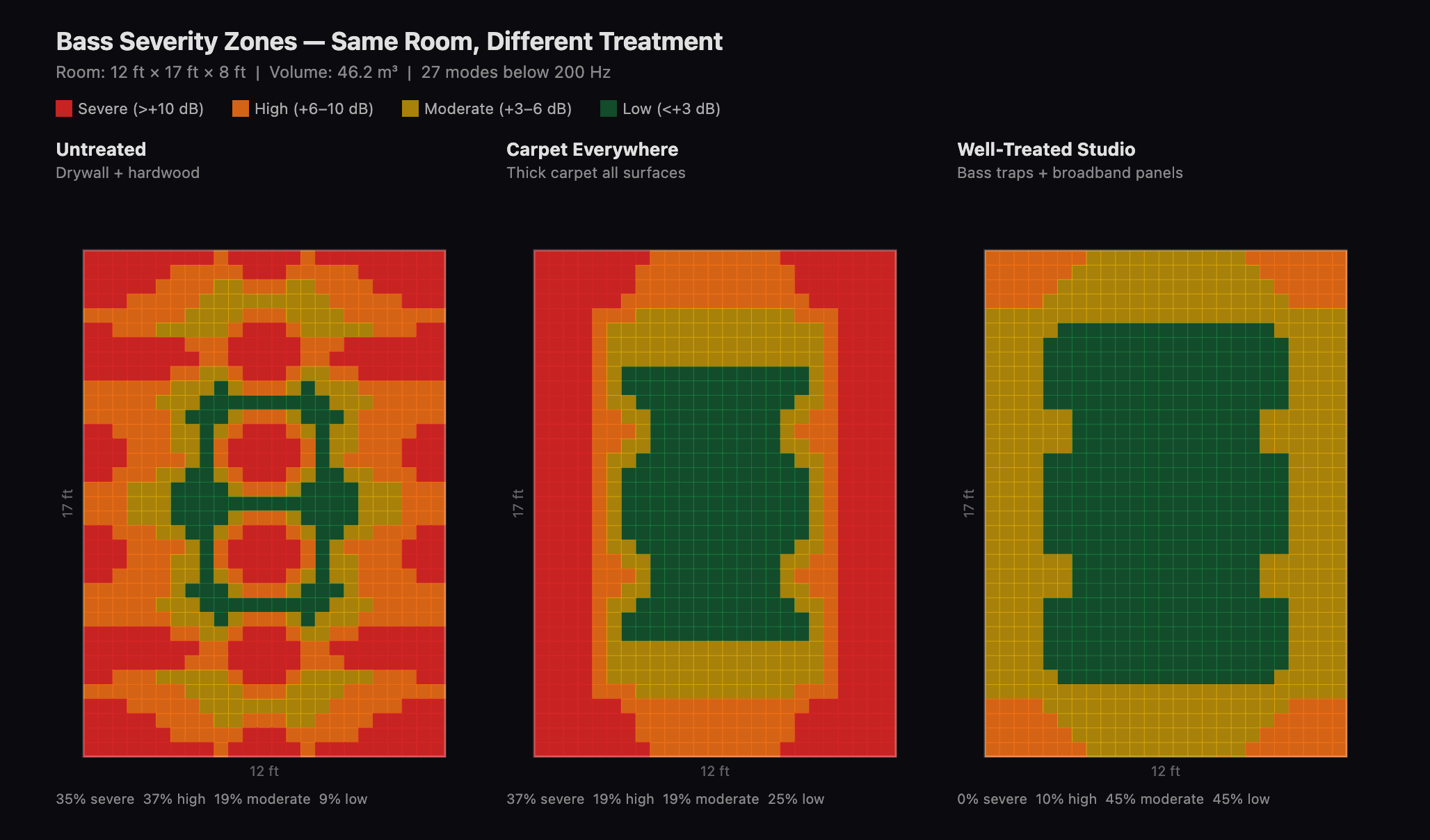
We modeled a typical 12 ft × 17 ft × 8 ft listening room and mapped every floor position by bass severity. The results show clear zones. Corners are always the worst: every mode has a pressure maximum where walls meet, so all that energy stacks up regardless of frequency. Edges along walls are next, with severity dropping as you move inward. The center of the room and areas about 1/3 from each wall tend to be the calmest.
An untreated room shows 35% of the floor in the severe zone (more than 10 dB above the room average) and only 9% in the low-impact zone. Add proper bass traps and the picture transforms: zero percent severe, 45% low-impact. The same modes exist, but their Q drops enough that spatial variation stops being a problem.
What this means for speaker placement
If you're placing speakers or a subwoofer in an untreated room, the zone map is your friend. Avoid the corners and first few feet along each wall. The sweet spot is usually 1/4 to 1/3 of the room width in from a side wall, and 1/3 to 2/5 of the length from the front wall. These positions dodge the worst pressure maxima for the dominant axial modes.
The exact best position depends on which modes your room has and which frequencies cluster together. A 12 × 17 room has different problem bands than a 14 × 20 room. That's why generic rules get you close but not all the way there.
If you have some bass treatment in place, the constraints loosen up. Moderate absorption drops the severity enough that more of the room becomes viable, giving you flexibility to optimize for stereo imaging or furniture layout.
The bottom line
Your room has dozens of modes. Most of them are not worth worrying about. The ones that matter are high-energy (axial), in bands where multiple modes cluster, and in rooms without much bass absorption. If your room is reasonably damped, or if you can position speakers away from the worst pressure zones, you can tame the bass without expensive treatment.
Atuund's room mode calculator maps these zones for your specific room dimensions and shows exactly where bass severity is highest, broken down by frequency band. It's a good starting point before moving a single speaker.
Frequently Asked Questions
How many room modes does a typical room have?
A typical listening room (12 ft × 17 ft × 8 ft) has roughly 27 modes below 200 Hz. But mode count alone doesn't tell you much. What matters is how many fall in the same frequency band, what types they are, and how much damping the room provides. A well-treated room can have the same number of modes as an untreated one and sound vastly better.
What is Q factor for room modes?
Q factor describes how sharp a resonance is. A high-Q mode rings for a long time and creates a narrow, prominent peak in the frequency response. A low-Q mode decays quickly and blends into the surrounding frequencies. Q depends on how much absorption the room has at that frequency. Below a Q of about 5, modes become barely perceptible.
What's the difference between axial, tangential, and oblique modes?
Axial modes bounce between two parallel surfaces and carry the most energy. Tangential modes bounce between four surfaces and carry roughly half the energy. Oblique modes involve all six surfaces and carry about a quarter. In practice, axial modes cause the most audible problems, especially in untreated rooms.
Atuund uses finite element method (FEM) modal analysis to model room acoustics. Built for hi-fi enthusiasts, home theater builders, and anyone who wants better sound from their speakers.