Why Carpet Won't Fix Your Bass Problem
Carpet is one of the most common "acoustic treatments" in home listening rooms. It's already there, it obviously deadens sound, and adding more seems like a cheap fix. Some people even staple carpet remnants to their walls.
There's just one problem: carpet does almost nothing for bass. And if bass is your issue (it usually is), you might be making things worse.
What carpet actually absorbs
Thick carpet has an absorption coefficient of about 0.57 at 500 Hz and 0.73 at 4,000 Hz. That's genuinely good absorption for mid and high frequencies. It's why a carpeted room sounds "deader" than a hardwood room when you clap your hands.
But at 125 Hz, the absorption coefficient drops to 0.08. At lower bass frequencies it's even less. This isn't a small difference. Carpet absorbs seven times more energy at 500 Hz than at 125 Hz. Bass wavelengths are physically long (a 50 Hz wave stretches over 20 feet) and they pass right through thin, lightweight materials like carpet as if it weren't there.
We modeled it
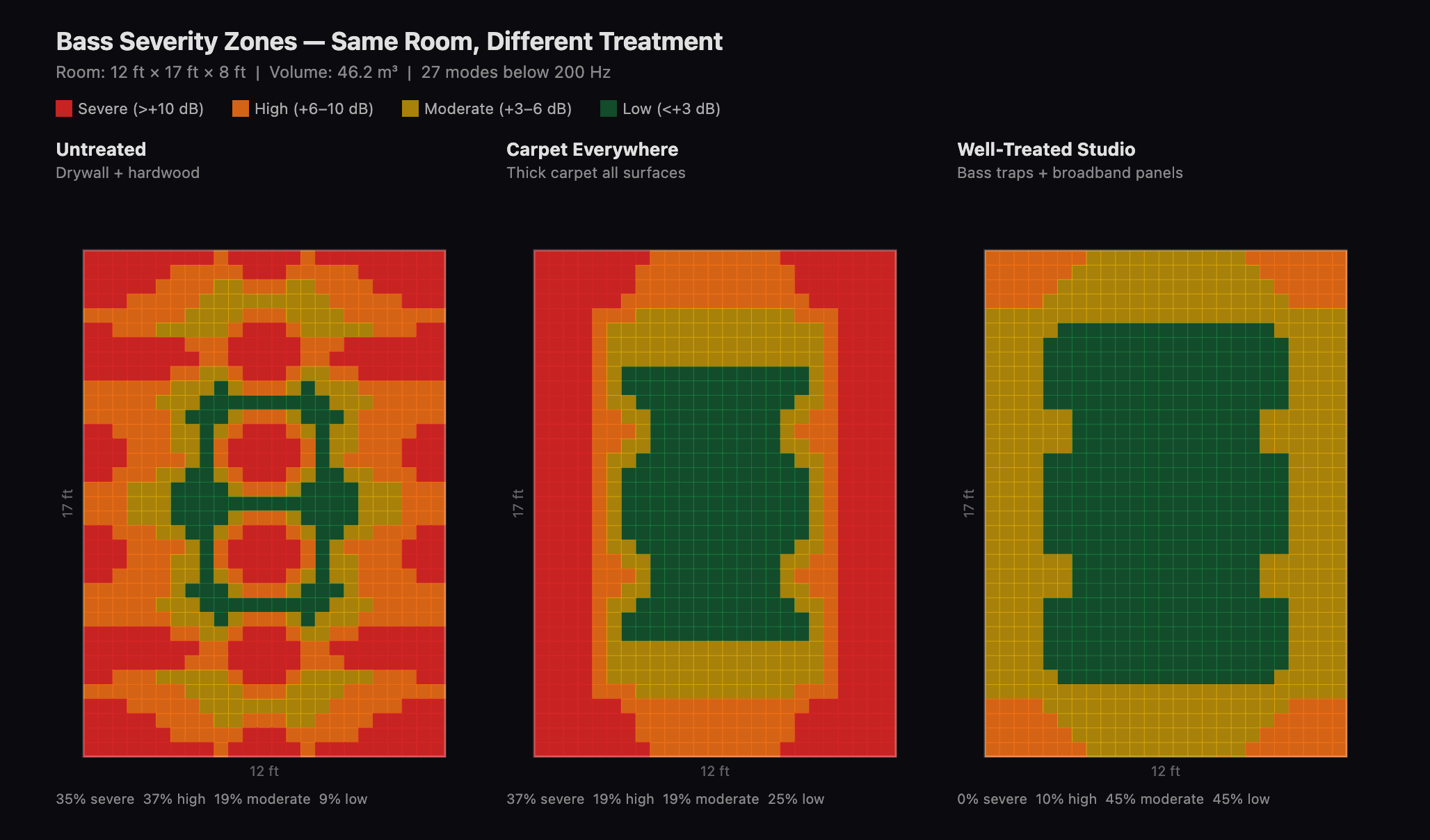
We took a standard 12 ft × 17 ft × 8 ft listening room and ran our bass zone model three ways: untreated (drywall walls, hardwood floor), carpet on every surface (walls, floor, ceiling), and properly treated (bass traps and broadband panels).
The untreated room: 35% of the floor area in the severe bass zone, 9% in the safe zone. Corners are hot, walls are problematic, and there's a complex interference pattern from 27 active modes.
Carpet everywhere: 37% severe. It actually got worse. The severe zone grew because carpet replaced the hardwood floor, which had slightly more bass absorption (0.15 at 125 Hz) than carpet (0.08). Meanwhile, the carpet killed the mid and high frequencies, dropping the 500 Hz T60 from 1.49 seconds to 0.16 seconds. The room sounds dead above 200 Hz but still booms in the bass. Worse, the lower Schroeder frequency means fewer modes are active, but the ones that remain are sharper (higher Q) because the bass T60 actually increased.
Proper treatment: 0% severe, 45% low-impact. The bass traps (absorption coefficient of 0.30 at 125 Hz) brought the low-frequency Q factors down from around 18 to around 7. Modes still exist, but they decay before they build up into audible resonances.
Why carpet can make bass sound worse
This is the counterintuitive part. A room with carpet everywhere doesn't just fail to fix the bass. It can make the bass more prominent by comparison. When you absorb the mids and highs but leave the lows untouched, the tonal balance shifts. The bass that was always there now dominates because the frequencies above it got quieter.
It's the same reason a room with heavy curtains and soft furniture can sound "boomy" even though it seems well-treated. The treatment is frequency-selective in exactly the wrong direction: it's absorbing what doesn't need absorbing and ignoring what does.
What actually works for bass
Bass absorption needs two things: mass and depth. The absorber has to be thick enough to interact with long wavelengths. At 80 Hz, a quarter wavelength is about 3.5 feet. You don't need absorbers that thick, but you need substantially more than half an inch of carpet.
Corner bass traps are the most effective per square foot because corners are where multiple modes have their pressure maxima. A 4-inch thick rigid fiberglass panel mounted across a room corner intercepts energy from every axial mode. Even two or four corner traps can noticeably reduce the Q of the worst modes.
Membrane absorbers (sometimes called panel traps) work differently. A thin panel mounted with an air gap resonates at a specific bass frequency and converts that energy to heat. They're thinner than porous traps but only target a narrow frequency range.
The key metric to watch is T60 at 125 Hz. In our model, untreated was 0.82 seconds (Q around 18 for a 50 Hz mode). The treated room brought that down to 0.31 seconds (Q around 7). You don't need to get Q below 5 for every mode. Getting from 18 to 10 already takes a mode from "severe" to "moderate."
Start with placement, then treat
Before spending money on bass traps, try moving your speakers and subwoofer. Placement controls which modes get excited. A subwoofer 3 feet from a corner instead of in it can cut a problematic mode by 6-8 dB without touching a single panel.
Once your speakers are in optimized positions, add treatment to address whatever bass problems remain. The two work together: placement reduces excitation of problem modes, treatment reduces how sharply those modes resonate. Either one alone helps. Both together can take a room from 35% severe to nearly zero.
Atuund's room mode calculator shows you exactly where your bass severity zones are, so you know what you're dealing with before you buy anything.
Frequently Asked Questions
Does carpet help with bass problems?
Almost not at all. Thick carpet absorbs about 57% of sound at 500 Hz but only 8% at 125 Hz. Bass wavelengths are physically long (a 50 Hz wave is over 20 feet) and pass right through thin, lightweight materials. Carpet can actually make bass sound worse by absorbing the mids and highs that were partially masking the boom.
What absorbs bass effectively?
Effective bass absorption requires mass and depth. Corner-mounted bass traps (at least 4 inches thick, ideally 6+), rigid fiberglass or mineral wool panels, and membrane/resonant absorbers are the main options. The absorber needs to be a meaningful fraction of the bass wavelength to interact with it. At 80 Hz, a quarter wavelength is about 3.5 feet.
How much bass treatment does a room need?
It depends on the room and the goal. For a typical untreated listening room, corner bass traps in just 2-4 corners can drop the Q factor of problematic modes enough to move them from "severe" to "moderate." Full professional treatment might cover 30-40% of wall area. The first few traps make the biggest difference.
Can I fix bass problems without any treatment?
Yes, often. Speaker and subwoofer placement is the single most effective lever. Moving a sub out of a corner can cut a 15 dB peak in half. Placement doesn't reduce mode energy, but it controls which modes get excited and how strongly. Start with placement optimization, then add treatment if needed.
Atuund uses finite element method (FEM) modal analysis to model room acoustics. Built for hi-fi enthusiasts, home theater builders, and anyone who wants better sound from their speakers.